
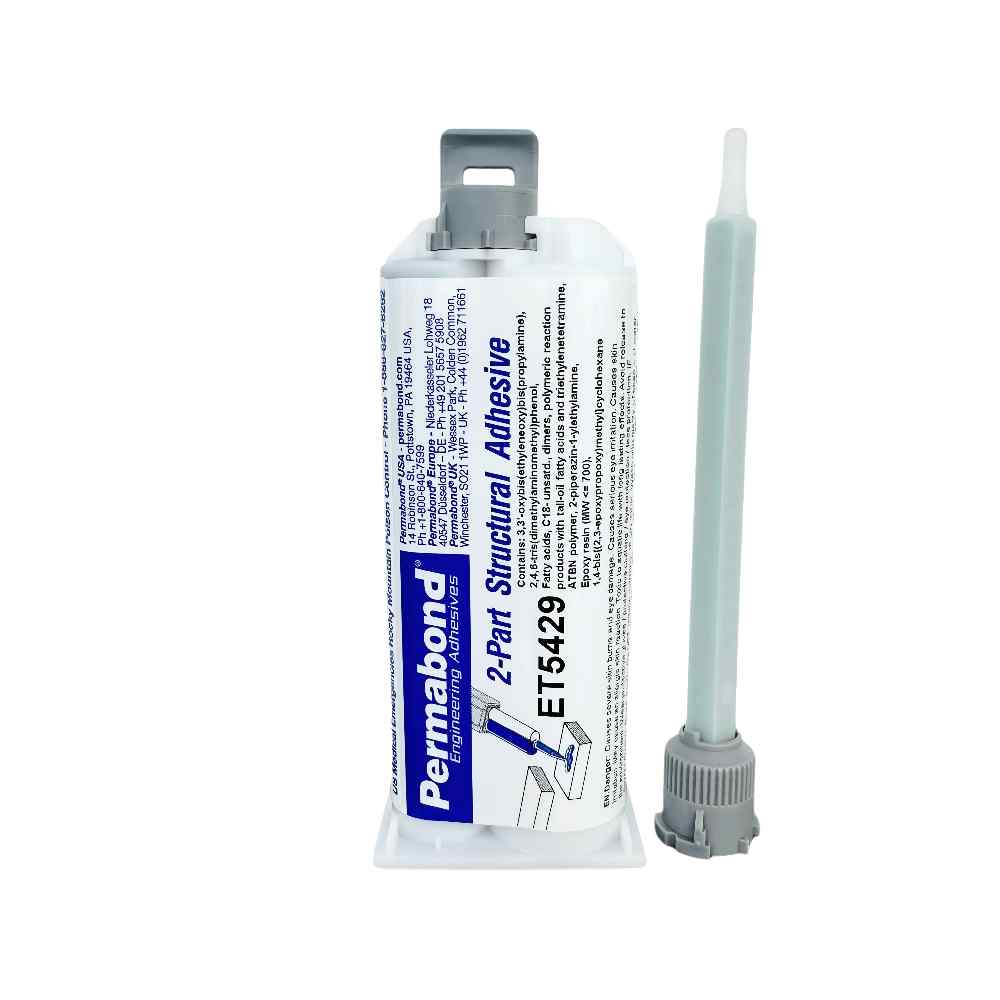
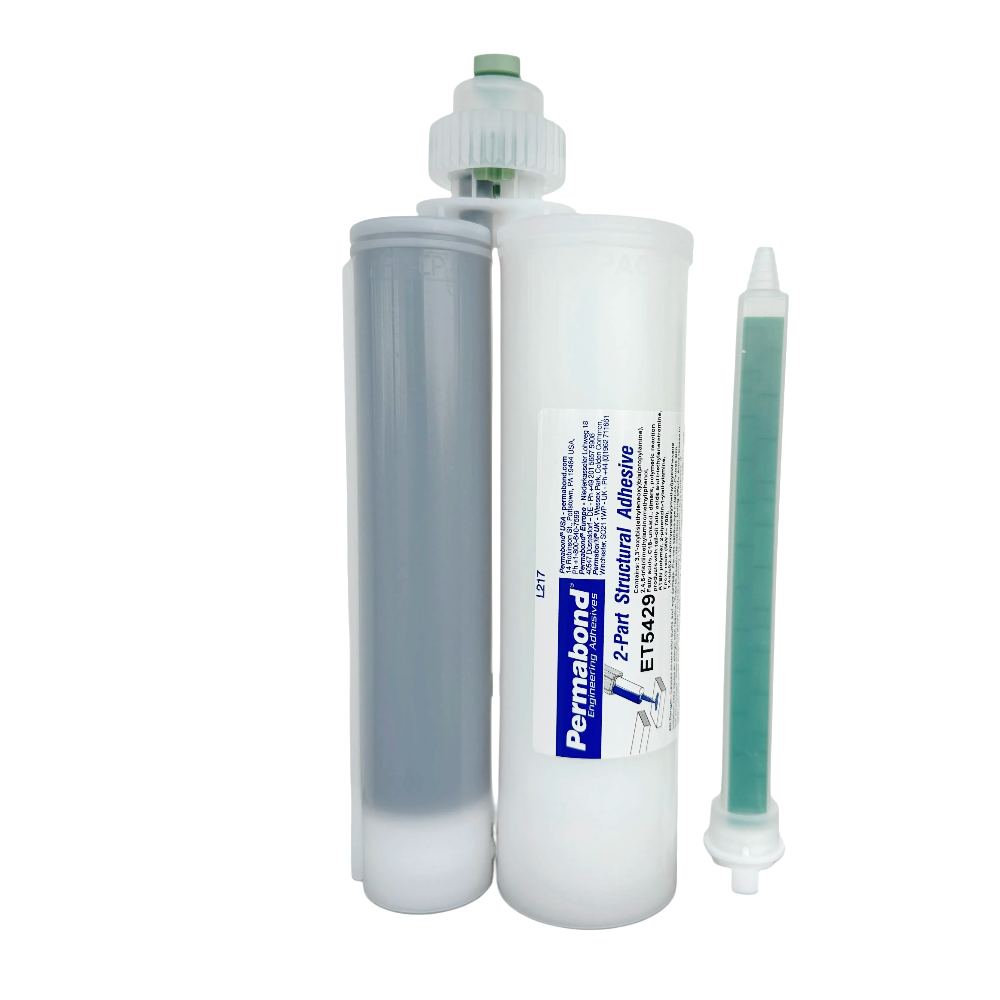
Structural epoxy for carbon fibre, fibreglass and metal
Permabond ET5429 is a two-part structural epoxy adhesive for bonding composite components to each other and to metals. Its long pot life allows time to position and align parts, while its thick, thixotropic consistency helps control flow on vertical surfaces and across gaps.
Designed for demanding composite assemblies, ET5429 combines high shear and peel strength with good resistance to impact and vibration. It cures at room temperature, with heat available to accelerate the process.
Typical applications
- Composite assembly: bonding carbon fibre and fibreglass panels, profiles, housings and other laminate components.
- Composite-to-metal joints: attaching metal brackets, inserts and fittings to composite parts.
- Industrial components: assembling panels and housings exposed to vibration or mechanical loads.
- Suitable composite repairs: joining prepared parts and filling local gaps where the repair design and required strength have been verified.
Bond strength by material
ET5429 is particularly suited to composite materials and metals. The following typical lap-shear strength values are reported in the manufacturer’s technical data sheet (ISO 4587).
| Material | Typical shear strength |
|---|---|
| Carbon fibre composite (CFRP) | >25 N/mm²* |
| Glass fibre/epoxy composite | 18–22 N/mm² |
| Glass fibre/polyester composite | >6 N/mm²* |
| Aluminium | 26–31 N/mm² |
| Mild steel | 23–28 N/mm² |
| Stainless steel | 25–30 N/mm² |
| PEEK | 4–5 N/mm² |
| PA6, 30% filled | 4–6 N/mm² |
| Polycarbonate (PC) | 3–4 N/mm² |
| PVC | >3 N/mm²* |
* Substrate failure was recorded in these tests. These are typical laboratory results, not design allowables or guaranteed values. Actual performance depends on the material, surface preparation, bondline gap and curing conditions.
Bonding plastics? Published strengths on the tested engineering plastics are lower than on metals and epoxy composites. Confirm suitability for the exact plastic grade and surface treatment. Do not assume compatibility with polyethylene (PE), polypropylene (PP) or PTFE.
Surface preparation
A durable bond starts with clean, dry surfaces. Remove contamination before abrasion so it is not worked into the surface.
- Degrease. Remove oil, grease and other contamination with a suitable cleaner, such as isopropyl alcohol (IPA) or acetone, only where compatible with the substrate.
- Prepare metals. Where appropriate, lightly abrade the surface. Aluminium, copper and their alloys benefit from abrasion to remove the oxide layer.
- Prepare composites. Remove mould-release residues and other contaminants using a process suitable for the laminate. If abrasion is required, avoid damaging the reinforcing fibres.
- Clean again and dry. Remove sanding dust and any remaining contamination. Allow the cleaning solvent to evaporate fully before applying the adhesive.
Application and curing
- Prepare the cartridge. Use a dispensing gun and static mixer compatible with the cartridge format and its 2:1 ratio. Before attaching the mixer, dispense a small amount until both components flow.
- Mix and apply. Dispense through the static mixer and check for a uniform charcoal-black mixture. For manual mixing, combine components A and B at 2:1 by volume or weight and mix thoroughly. Apply to one prepared surface.
- Assemble and secure. Join and position the parts within the usable pot life. Hold them securely with suitable clamping pressure until handling strength is reached.
- Allow the joint to cure. Keep the assembly undisturbed during initial curing. Do not apply the intended service load until the required strength has developed.
| Curing stage | At 23 °C | At 60 °C |
|---|---|---|
| Handling time | 6–10 hours | Not specified |
| Working strength | 24 hours | 1 hour |
| Full cure | 72 hours | 2 hours |
Pot life is not curing time. The stated 2–4 hours is the usable life of a 10 g mixture at 23 °C. Larger mixed quantities and higher temperatures shorten this time; lower temperatures slow curing.
Additional technical data
| Property | Typical value |
|---|---|
| Adhesive type | Two-part structural epoxy |
| Consistency | Thixotropic paste |
| Mixed colour | Charcoal black |
| Peel strength on aluminium (ISO 4578) | 150–230 N/25 mm |
| Impact strength (ASTM D-950) | 30–40 kJ/m² |
| Hardness (ISO 868) | 65–75 Shore D |
| Elongation at break (ISO 37) | <5% |
| Glass transition temperature (Tg) | 50–60 °C |
| Dielectric strength | 15–25 kV/mm |
| Storage temperature | 5–25 °C |
Temperature and use limits
Bond strength changes with temperature. The 50–60 °C glass transition temperature (Tg) is not a maximum service-temperature rating. Confirm suitability for the actual temperature, loading and exposure time of the application.
The manufacturer states that the cured adhesive can be exposed to temperatures down to approximately −40 °C, depending on the bonded materials. Brief exposure to higher temperatures may be possible if the joint is not unduly stressed.
Not recommended for contact with strong oxidising materials. Food-contact, drinking-water and other regulated applications require separate confirmation of suitability.
Frequently asked questions
Is ET5429 suitable for carbon fibre?
Yes. It is intended for composite assemblies, including carbon fibre components bonded to composites or metals. The published carbon fibre test result exceeded 25 N/mm², with substrate failure recorded.
Can it be applied to vertical surfaces?
Yes. Its thick, thixotropic consistency helps limit sagging and allows gap filling up to 5 mm.
Does it need heat to cure?
No. Full cure is typically reached after 72 hours at 23 °C. Heating to 60 °C reduces the stated full-cure time to 2 hours, provided the assembly is suitable for that curing temperature.
Which dispensing gun do I need?
Choose a gun and static mixer that match both the cartridge format and the 2:1 ratio. A gun compatible with both 1:1 and 2:1 cartridges may be suitable; check the cartridge dimensions and plunger configuration.
For professional or industrial use only. Keep out of reach of children.
Before use: read the current safety data sheets for components A and B. Confirm the adhesive and joint design through testing before production or structural repair. Technical strength values do not certify a finished structure.


