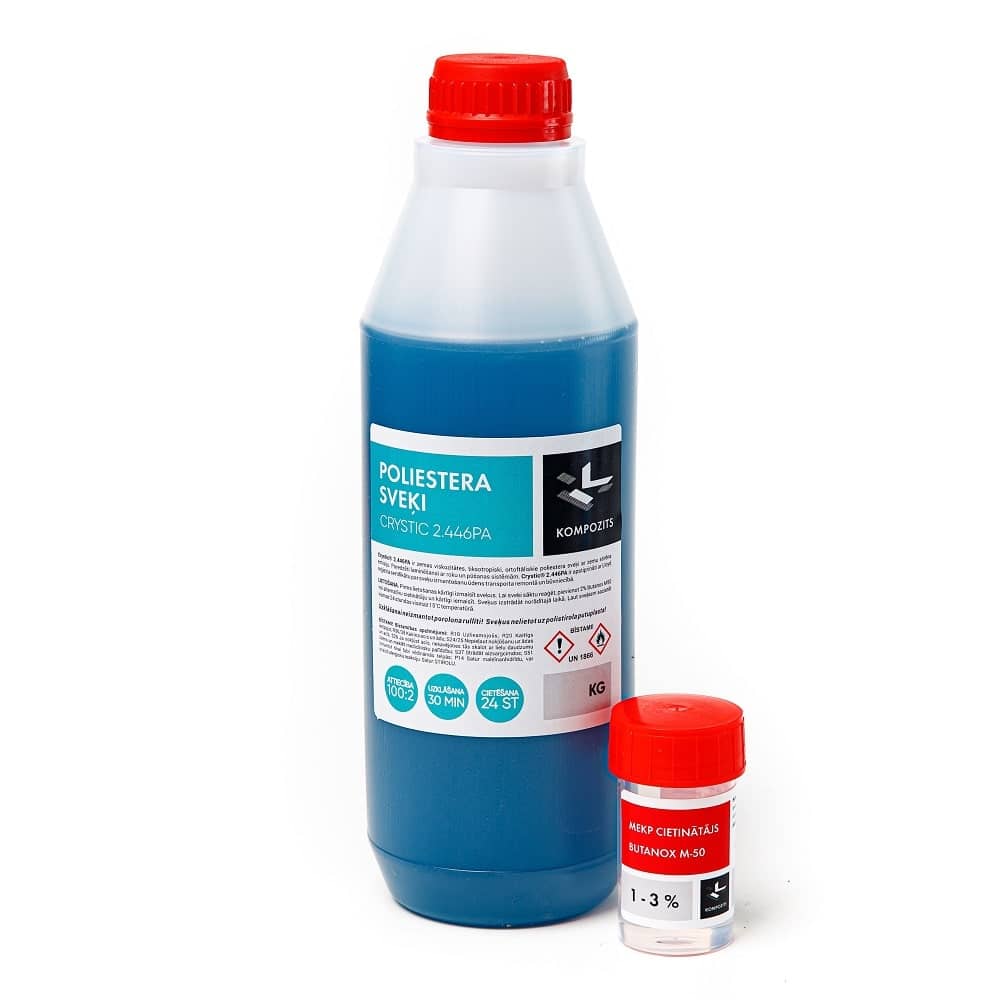
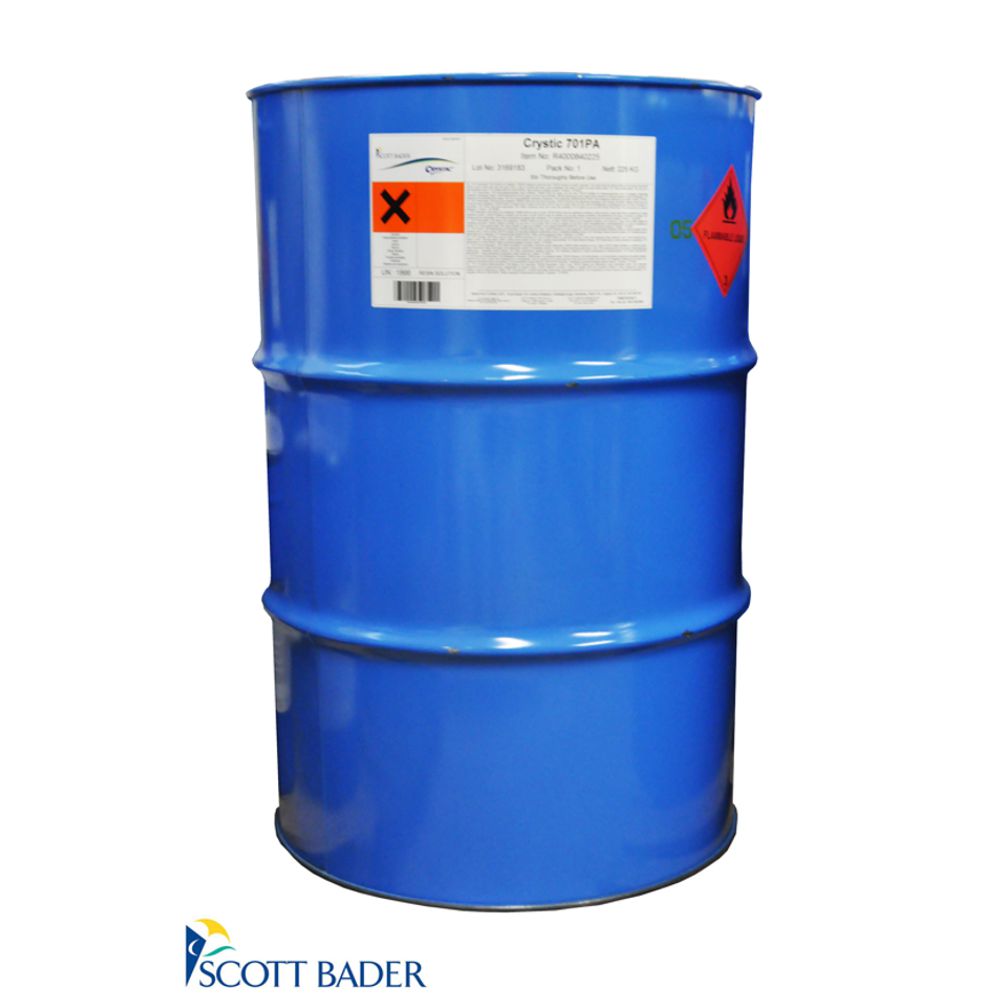
Scott Bader Crystic® 701PA Polyester Resin for Vacuum Infusion
Crystic® 701PA is a pre-accelerated, low-viscosity isophthalic polyester resin,
designed for vacuum infusion and vacuum injection molding in the manufacture of composite materials.
It ensures effective impregnation of glass, carbon, and aramid fiber reinforcements,
particularly in the manufacture of large and structurally complex parts.
Low viscosity ensures a steady flow of resin through the mold, while the controlled exothermic reaction
and a sufficiently long processing window allow for reliable work with large molds and complex geometries.
Key Benefits
- Low viscosity for effective wetting of the reinforcement and uniform resin flow.
- Intended for vacuum infusion and closed-mold processes (RTM, VARTM).
- Pre-activated system—simply add the specified peroxide catalyst.
- Compatible with glass, carbon, and aramid fiber laminates.
- A controlled exothermic reaction reduces the risk of overheating in thick laminates.
- Suitable for the manufacture of large composite parts and structures.
- Curing is possible at room temperature.
Recommended Use
Crystic® 701PA is suitable for the following applications:
- vacuum infusion processes;
- vacuum infusion (RTM / VARTM);
- glass fiber laminates;
- carbon and aramid fiber composites;
- boat hulls and marine industry components;
- transportation and industrial panels;
- large structural or semi-structural composite parts;
- sandwich structures with proven core materials.
Note: These resins are not primarily intended for hand lamination. Thixotropic polyester resins are generally more suitable for this process.
Technical Information
| Parameter | Typical value |
|---|---|
| Resin Type | Isophthalic unsaturated polyester resins |
| System | Previously accelerated |
| Color | A purplish shade |
| Viscosity at 25 °C | ~160 mPa·s |
| Density | ~1.08 |
| Catalyst | Catalyst M or Butanox M50 |
| Amount of catalyst | 1–2% |
| Operating temperature | ~18–20 °C (min. 15 °C) |
| Shelf Life | Up to 6 months |
| Tensile strength | ~66 MPa |
| Modulus of elasticity | ~3,580 MPa |
| Extension | ~2.5% |
| Barcol hardness | ~35 |
| Heat distortion temperature | ~75 °C |
The values listed are typical laboratory data. The properties of the finished laminate depend on the process,
the reinforcement, and the curing conditions.
Use
- Condition the resin, mold, and fittings to the working temperature.
- Prepare the mold and apply the appropriate release agent.
- Set up the fittings, flow materials, and vacuum system.
- Check the vacuum seal.
- Add 1–2% of the catalyst and mix thoroughly.
- Perform the infusion in a controlled treatment window.
- Allow it to harden completely before disassembly.
Important: A large amount of resin mixed with a hardener can significantly accelerate the reaction and cause it to overheat or even result in a boiling reaction.
Calculation of Resin Quantity
The required amount of resin is calculated based on the dry weight of the reinforcement and the fiber-to-resin ratio.
Mass of dry screed = area × g/m² × number of layers ÷ 1000
It is recommended to add a 10–20% process margin.
You may also need
- Butanox M50 or another catalyst
- Vacuum film and sealing tape
- Peel ply and flow screen
- Vacuum Pump and Connections
- Glass, carbon, or aramid fibers
- Protective Equipment
The required amount of Butanox M-50 catalyst or hardener is included in the kit.
Safety
Polyester resins contain flammable and volatile substances. Work in a well-ventilated area and avoid sources of ignition.
Wear protective gloves, safety goggles, and appropriate clothing. Do not inhale the fumes.
Required: Read the Safety Data Sheet (SDS) and Technical Data Sheet (TDS) before use.
Storage
Store at 5–25 °C in a dry, well-ventilated place in the original packaging. Protect from heat, frost, and sunlight.
FAQ
Is Crystic® 701PA suitable for vacuum infusion?
Yes, they are specifically designed for vacuum infusion and RTM processes.
Can it be used for hand lamination?
Not recommended—it is better to use thixotropic resins.
Which catalyst should be used?
Catalyst M or Butanox M50 at a concentration of 1–2%.
Warnings and Safety Instructions
Signal word: Danger
Hazard Statements (H-statements): H226 – Flammable liquid and vapors. H315 – Causes skin irritation. H317 – May cause an allergic skin reaction. H319 – Causes serious eye irritation. H332 – Harmful if inhaled. H335 – May cause respiratory tract irritation. H361d – Suspected of causing harm to the unborn child. H372 – Causes damage to organs through prolonged or repeated exposure (hearing organs). H412 – Harmful to aquatic life with long-lasting effects.
Precautionary statements (P-statements): P210 – Keep away from heat, hot surfaces, sparks, open flames, and other sources of ignition. Do not smoke. P211 – Do not spray onto an open flame or other ignition sources. P251 – Do not incinerate or burn, even after use. P261 – Avoid inhaling vapors. P273 – Do not release into the environment. P391 – Collect spilled material. P403 + P233 – Store in a well-ventilated area. Keep container tightly closed. P410 + P412 – Protect from sunlight. Do not store at temperatures above 50°C. P501 – Dispose of used contents/container at a hazardous or special waste collection point.
Response:
IN CASE OF CONTACT OR POISONING: Contact a Poison Control Center or a doctor. IF INHALED: Provide fresh air; rest. SKIN CONTACT: Wash with plenty of water; remove contaminated clothing; if skin irritation or a rash persists—seek medical attention. EYE CONTACT: Rinse with water for several minutes; remove contact lenses if possible; if irritation persists, seek medical attention.
Storage: Store in a well-ventilated area. Keep the container tightly closed.
Disposal: Dispose of the contents and packaging in accordance with local, regional, national, and international regulations.
Hazard pictograms: